TL;DR
The days between Christmas and New Year create a rare shared pause in public life. That pause matters. Peace does not emerge from constant urgency, it requires space for reflection, foresight, and restraint. Modern systems are designed for speed and reaction, not judgement or prevention. Goodwill alone cannot sustain peace without structures to hold it. A Ministry for Peace exists to institutionalise pause and long-term thinking so peace becomes a public capability, not a seasonal wish.
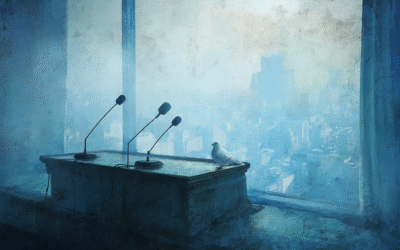
Most people experience this as a lull, an inconvenience, or a chance to catch up. Few name it for what it is. A rare shared pause. A liminal space. A moment when the collective nervous system exhales.
That pause matters more than we realise.
Peace does not begin with action. It begins with space. Modern societies have almost entirely forgotten how to make room for it.
This is why the days between years matter, and why peace cannot be built at speed.
The strange week that belongs to no one
The days between Christmas and New Year feel different because they are different. The usual rhythms of productivity loosen. Emails slow. Meetings thin out. Even conflict feels muted. Not resolved, but suspended.
Anthropologists describe this kind of time as liminal. It sits between what was and what comes next. In many cultures, liminal periods were treated with care. They were understood as moments when meaning settled, relationships recalibrated, and direction was reconsidered before movement resumed.
Modern life has little patience for this kind of time. We prize output, momentum, and visible results. Anything that does not produce a measurable outcome is treated as indulgent or inefficient.
And yet almost everyone recognises that this in-between week feels restorative in a way no productivity tool ever does. That recognition is not nostalgia. It is information.
What liminal time does to human judgement
When urgency drops, perception widens. This is not philosophy. It is physiology.
Under sustained pressure, the human brain narrows its field of attention. Threat detection increases. Complexity becomes harder to hold. Decision-making shifts toward short-term survival rather than long-term sense-making.
This state is useful in emergencies. It is damaging when it becomes permanent.
Liminal time allows integration. Experiences settle. Emotions are processed. Perspectives shift. People become less reactive and more reflective, not because they are trying harder, but because the conditions allow it.
Peace depends on this state. Not as a feeling, but as a capability. The capability to sit with complexity without rushing to reduce it. To listen without immediately countering. To choose restraint over escalation.
These capacities do not develop under constant urgency.
How modern systems eliminated pause
Most contemporary systems are designed for throughput, not discernment. Political cycles reward immediacy. Media cycles reward outrage. Economic models reward speed and extraction. Digital platforms reward reaction.
In these systems, pause looks like failure. Reflection looks like weakness. Slowing down appears irresponsible.
Even when leaders speak about long-term thinking, the structures around them make it difficult to practise. There is always another crisis, another headline, another deadline. Space only appears when something breaks.
This is not a failure of goodwill. It is a design problem.
We built systems for motion, not for wisdom.
Why peace cannot be built at speed
Peace is often mistaken for an absence. No war. No violence. No visible conflict. In practice, peace is an active condition that requires care, foresight, and maintenance.
Reconciliation takes time. Trust repair takes time. Conflict prevention takes time. Social cohesion takes time. When these processes are rushed, outcomes distort.
History is full of peace efforts that faltered because they moved too quickly. Agreements reached without listening. Reconstruction imposed without trust. Policies introduced to signal progress that later deepened division.
Speed creates the appearance of resolution. It rarely creates the substance.
Peace cannot be added onto systems designed for competition or dominance. It must be built into the structure itself.
The limits of goodwill without structure
The end of the year brings a surge of goodwill. People soften. They give more. They speak more kindly. This reflects a genuine human impulse toward connection.
The problem is not goodwill. The problem is that goodwill fades when it is not supported.
Without structures to hold it, goodwill becomes seasonal. It peaks, then dissipates. By January, people return to systems that reward urgency, defensiveness, and short-term thinking.
This is not a moral failure. It is a structural one.
Peace cannot depend on people being kinder when conditions are gentle. It must be supported when conditions are hard.
What a Ministry for Peace changes
A Ministry for Peace is often misunderstood as symbolic. In practice, it is functional.
It creates institutional space for reflection, foresight, and prevention. It formalises pause as part of governance, just as other ministries formalise security, health, or finance.
Its work includes long-term conflict prevention analysis, not just crisis response. It tracks social cohesion beyond economic indicators. It examines policy impacts across generations, not just electoral terms. It coordinates across departments where relational harm often accumulates unnoticed.
Every complex system needs a function that looks ahead and slows decisions when speed increases risk. Peace work performs that function.
Without it, governments remain reactive, managing damage rather than preventing it.
The New Year illusion
Each January promises renewal. New goals. New priorities. New language. Yet the underlying systems remain largely unchanged.
Individuals know this pattern well. Resolutions falter not because people lack discipline, but because they return to environments that reinforce old habits. Nations follow the same pattern.
Without structural pause, nothing truly resets. Time advances, but direction holds.
Peace framed as aspiration rarely survives the first quarter of the year because it is not resourced, protected, or embedded.
Reclaiming the pause without nostalgia
This is not about returning to a religious past or a simpler era. It is about recognising a durable human insight and updating it for a plural, secular society.
All cultures understood the need for pause. They named it differently. They observed it differently. But they shared the understanding that constant motion erodes judgement.
Modern societies need secular equivalents. Protected spaces for reflection. Institutions that value restraint. Policies designed with time horizons longer than the next crisis.
A Ministry for Peace is one such institution.
A quieter way to begin a year
The days between Christmas and New Year remind us of something rarely acknowledged. Life feels more human when it is not rushed.
Peace grows in that space. Not as sentiment, but as clarity. Not as hope, but as capacity.
As another year turns, the question is not whether we wish for peace. Most people already do. The question is whether we are willing to give it room.
Peace does not arrive with the calendar. It arrives when we design for it.





0 Comments